
















No products in the cart.
Why UAE Businesses Struggle Without an ERP System and How to Fix It
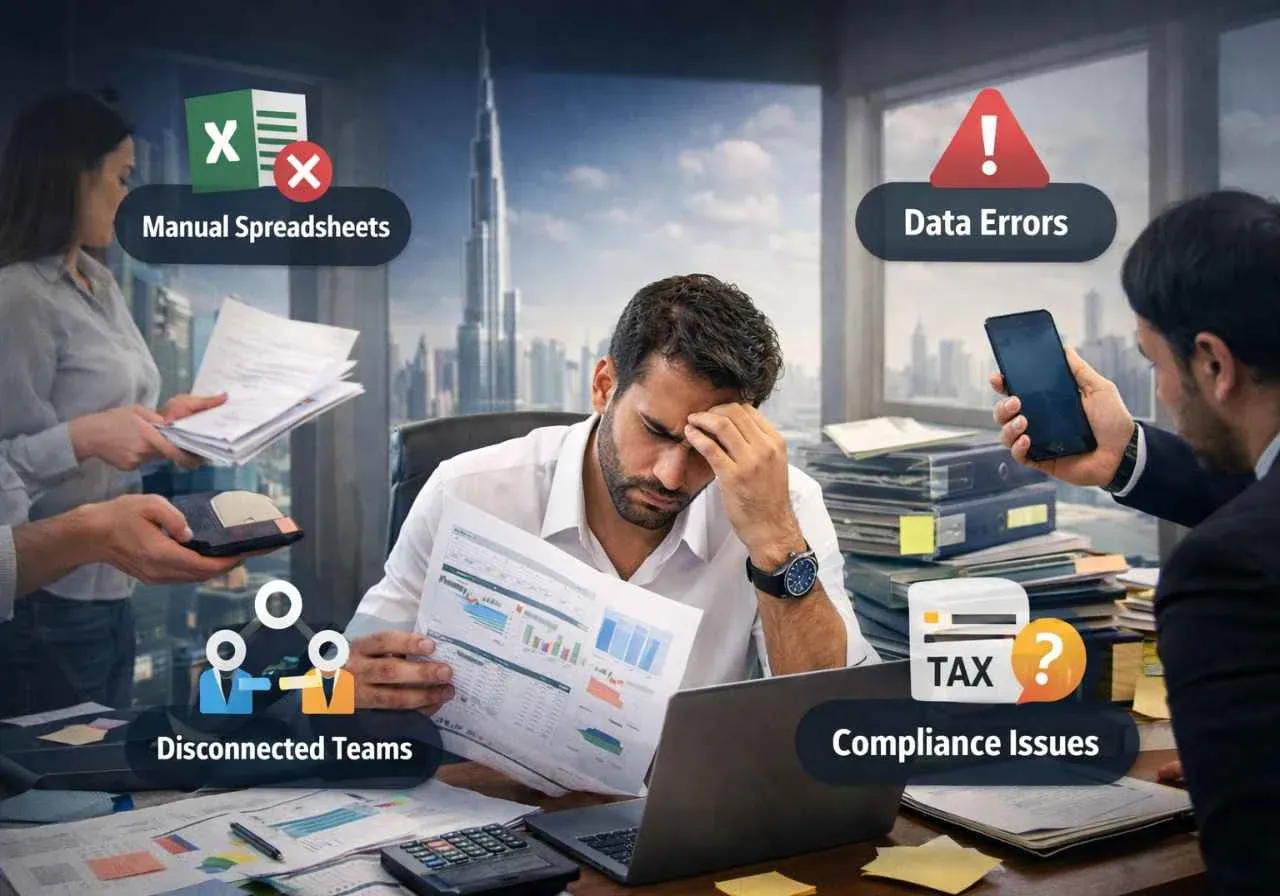
Growth looks good from the outside. There are orders coming in, teams are expanding with new branches, new clients, and more transactions. But inside many UAE businesses, the daily workflow still depends on spreadsheets, WhatsApp follow-ups, disconnected software, and too much manual checking.
That is exactly why many businesses struggle without an ERP system.
A business can survive like that for a while, but it does not stay efficient for long. In a market like the UAE, where businesses are expected to move fast and stay compliant with VAT, corporate tax, and the country’s evolving e-invoicing framework, that kind of setup creates pressure very quickly.
VAT in the UAE remains 5%, VAT registration becomes mandatory once taxable supplies and imports exceed AED 375,000, and registered businesses generally need to file VAT returns within 28 days from the end of the tax period. The UAE Ministry of Finance has also made clear that UAE e-invoicing is moving forward through a phased rollout, with the pilot phase beginning on 1 July 2026.
That is exactly why more companies are now looking at ERP software that they can actually use in daily operations to eliminate ERP challenges for UAE organizations.
Why do UAE businesses struggle without an ERP system?
- Disconnected data across departments
- Manual accounting errors
- No real-time business visibility
- Inventory mismatches
- Increasing compliance pressure
These are the most common challenges businesses in the UAE face when operating without a centralized system.
What Happens When Businesses Operate Without an ERP System?
The biggest issue is not just “working manually.” It is working without a reliable source of truth. When a company operates without ERP, data lives in too many places. It means sales updates on one sheet. At the same time, accounts update another. People check inventory through calls or messages. Simultaneously, HR keeps its own files. When management asks for a report, someone has to collect numbers from four or five places before they can answer.
This is where business process inefficiency in the UAE begins to show up in real life. Work gets repeated. Numbers stop matching, and teams spend time verifying basic information instead of acting on it. Even simple decisions start taking longer than they should.
Key problems without an ERP system in the UAE companies
Businesses in the UAE face several challenges when operating without a centralized system
- Manual Accounting Errors and Financial Confusion
This is one of the first cracks to show. When accounting depends heavily on spreadsheets, repeated data entry, and separate records across departments, small mistakes multiply fast. One invoice may be entered twice. A payment update may be missed. A VAT figure may be pulled from an older sheet.
These are the manual accounting problems in the UAE that businesses quietly deal with more often than they admit. Finance teams end up spending too much time correcting mistakes that should not have happened in the first place. Instead of focusing on cash flow, forecasting, and control, they are stuck in confusion.
- Lack of Real-Time Business Data
A lot of business decisions in the UAE need to be made quickly, like pricing changes, order movement changes, project cost changes, payment positions changes, and more.
Without ERP, most businesses are not working with live numbers. They are working with yesterday’s file, last week’s report, or whatever version someone has sent via email. That delay affects decision-making and leads to data management issues in UAE companies.
- Inventory and Stock Mismanagement
The lack of automation in business in the UAE hurts both trading and manufacturing businesses very quickly.
Without an integrated ERP setup, stock movement is often tracked manually or in disconnected systems. That leads to overstocking in one area and stockouts in another. Products that look available on paper may not actually be available physically. For that, reorder points get missed, and dispatch teams work under pressure because the system is not giving them clarity.
For UAE companies handling multiple warehouses, high-volume trading, imports, or fast-moving retail operations, this becomes even more expensive. Missed stock visibility is not just an operations issue. It affects sales, customer trust, and cash flow.
- Poor Department Coordination
One department finishing its task does not mean the next department has the right information.
Without ERP, sales, accounts, purchasing, inventory, and HR often work in separate software or manual workflows. That means one team may update a record while another team continues working from older information. The result is confusion, unnecessary calls, approval delays, and blame shifting.
This is one of the most common operational challenges for SMEs in the UAE that businesses face as they grow. What worked when the company had a small team starts breaking when more people get involved. Processes become dependent on individuals instead of systems. That is risky. Because when one person is absent, the whole flow slows down.
- Compliance and Reporting Issues in the UAE
Compliance pressure in the UAE is real, and it is getting more structured, not less.
Businesses already need clean records for VAT and corporate tax compliance, and the UAE’s official e-invoicing framework is now moving into implementation. The UAE Ministry of Finance states that electronic invoicing will apply broadly to persons conducting business in the UAE, with onboarding starting through a pilot programme from 1 July 2026, and businesses within scope will work through approved or pre-approved service providers under the framework.
If records are incomplete, spread across systems, or manually adjusted too often, reporting becomes harder, audits become more stressful, and compliance work takes longer than it should.
Why UAE Businesses Struggle Without an ERP System
The UAE is not a market where businesses can afford slow internal systems for very long.
Companies here often deal with multiple branches, multilingual documentation, imports, project-based billing, fast procurement cycles, regional trade, and strict reporting expectations. Many are also in active growth mode. That means the old method of managing operations through spreadsheets and separate tools starts failing much faster.
These are real ERP challenges for UAE companies, but the bigger truth is this - the challenge is often not ERP itself. The real challenge is trying to grow without it.
Once a business starts adding more departments, more approvals, more customers, and more compliance responsibility, disconnected processes stop being manageable and become expensive.
How ERP Systems Solve These Problems
ERP does not magically fix a business overnight. But it does remove a lot of the friction that keeps daily operations messy.
Centralized Data Management
ERP puts business information into one connected system. Instead of different teams maintaining separate versions, everyone works from the same platform. That means a sales update can reflect in finance. A purchase entry can reflect in stock. And Management can review performance without waiting for someone to build a report manually.
Automated Accounting and Finance
ERP reduces repeated manual entry and improves consistency across transactions.
Invoices, tax records, ledgers, receivables, payables, and reporting all become easier to manage when finance is built into the wider business workflow. This matters even more in the UAE, where tax records need to be maintained properly for VAT and corporate tax compliance.
Reporting Dashboards
One of the biggest ERP benefits for UAE companies is visibility. Instead of waiting until the end of the week or month, management can see current numbers as work happens. Sales, cash position, stock movement, purchase status, and department-level performance become easier to review and act on. Overall, it improves decision quality.
Inventory and Supply Chain Control
ERP improves stock control by connecting purchases, sales, warehouse movement, and availability in one system. That makes it easier to avoid stockouts, reduce dead stock, manage reorder levels, and improve dispatch planning. For businesses working across locations, this is often one of the fastest areas where ERP starts showing real value.
HR and Payroll Automation
ERP also helps, where businesses often underestimate the damage caused by manual work. Employee records, attendance, leave, payroll, approvals, and department coordination become more structured. That reduces errors, cuts down follow-up work, and gives management better operational visibility.
Real Business Impact of ERP in UAE Companies
When ERP is implemented properly, the improvement is usually felt in very practical ways.
● Teams stop chasing information.
● Finance closes faster.
● Management gets reports without asking three people to prepare them.
● Inventory becomes easier to trust.
● Approvals move with less confusion.
● Compliance preparation becomes less painful.
This is where business software integration for UAE companies stops being a technical discussion and becomes a business performance decision. ERP helps reduce operational waste, improve accountability, and create a setup that can actually support growth.
That is why many companies eventually move toward an Best ERP software so businesses can grow instead of continuing to patch old processes with more files and more manual work.
ERP Implementation Challenges
Yes, implementation can go wrong. Usually not because ERP is a bad idea, but because the process is handled badly.
The most common issues are poor planning, choosing the wrong vendor, weak process mapping, and not training users properly. Businesses also make mistakes when they try to force old habits into a new system instead of improving the process itself.
The safest approach is to define your workflows clearly, choose a vendor that understands your industry, keep implementation phased where needed, and make sure users know how the system supports their daily work.
That is how you reduce ERP implementation challenges in the UAE before they become expensive.
How to Fix The Issues Step by Step
If a business is already feeling the pressure, the answer is not to add more spreadsheets. It is to clean up the structure behind the work.
- Audit Current Business Processes
Start by identifying where delays, repeated entries, and approval gaps actually happen. Look at sales, accounting, purchasing, inventory, HR, and reporting flow.
- Identify Disconnected Systems
List the software, sheets, manual logs, and separate records that different teams are using. Most companies are surprised by how fragmented the setup has become.
- Choose a Reliable ERP software
Do not choose software only for today’s problems. Choose a system that can support future departments, more users, compliance needs, and reporting requirements.
- Prefer Cloud-Based ERP Where It Fits
For many growing companies, cloud ERP Dubai solutions make practical sense because access, updates, and visibility become easier across locations and teams.
- Train People Properly
Even a good integrated system can fail if users are not trained well. Adoption matters as much as software selection.
This is the most realistic answer to how to fix manual business processes in UAE companies, not by working harder inside broken workflows, but by replacing broken workflows with connected ones.
When Should a UAE Business Implement ERP?
A lot of businesses wait too long. The right time is usually when one or more of these signs start showing up:
● The team has grown beyond 10 to 20 employees
● Multiple departments are now involved in one transaction flow
● Reports take too long to prepare
● Stock mismatches happen often
● Finance spends too much time correcting entries
● Management cannot get live visibility
● Compliance work feels more stressful every quarter
ERP should not be treated as something only large enterprises need. Many SMEs need it much earlier than they think, especially once growth starts creating complexity.
The problem is not just that manual work takes longer.The real issue is that without a structured system, businesses gradually lose control over their operations.
Without ERP, UAE businesses often end up dealing with delayed reports, accounting confusion, disconnected teams, stock issues, and growing compliance pressure. Those problems may seem manageable for a while, but they become serious once the business starts expanding.
A good system brings structure back into the business. It connects departments, improves visibility, reduces manual errors, and gives management a stronger grip on operations.
If your business is already feeling these gaps, this is the point where continuing the old way usually costs more than fixing it.
Explore an ERP software built for growing operations. And if you are looking for a more practical ERP solution that UAE companies can use across finance, inventory, sales, HR, and reporting, Elate ERP is worth serious consideration.
FAQs
- What problems does ERP solve in UAE businesses?
ERP solves key operational issues such as disconnected data, manual accounting errors, delayed reporting, inventory mismatches, and poor coordination between departments. It also helps UAE businesses manage VAT, corporate tax, and upcoming e-invoicing requirements more efficiently.
- Why do UAE companies need an ERP system?
UAE companies need an ERP system to handle growing operations, multiple departments, and strict compliance requirements. ERP provides a centralized platform that improves accuracy, visibility, and overall business control.
ERP improves efficiency by automating repetitive tasks, reducing manual data entry, and connecting departments in one system. This allows businesses to access real-time data and make faster, more accurate decisions.
- What happens if a business does not use ERP?
Without ERP, businesses often face data inconsistencies, reporting delays, inventory issues, and increased manual errors. Over time, this reduces efficiency, increases costs, and makes compliance harder to manage.
- Is ERP suitable for small businesses in the UAE?
Yes, ERP is suitable for small and growing businesses in the UAE. It helps build structured processes early, reducing manual errors and making it easier to scale operations efficiently.
- How do manual processes affect UAE businesses?
Manual processes lead to delays, data mismatches, and increased dependency on follow-ups. In fast-growing UAE businesses, this creates operational inefficiencies and slows down decision-making.
- How can UAE businesses fix manual workflows?
UAE businesses can fix manual workflows by auditing current processes, identifying disconnected systems, and implementing an ERP system to centralize operations and improve efficiency.
SMEs in the UAE need ERP software to manage growth, streamline operations, and handle increasing compliance requirements. ERP helps reduce complexity and improves overall business control.
- How does ERP help with compliance in the UAE?
ERP helps by maintaining accurate records, automating tax calculations, and simplifying reporting. This supports compliance with UAE VAT, corporate tax, and the upcoming e-invoicing framework.
- What is the best way to manage business operations in the UAE?
The most effective way is to use a centralized business management system like ERP that integrates finance, inventory, sales, and reporting. This improves visibility, control, and scalability.