











No products in the cart.

ERP Software UAE 2026: Cost, Features, ROI & Best Systems in Dubai
ERP Software UAE has moved from being a “big company system” to a practical business solution for companies that want tighter control, cleaner reporting, and fewer manual gaps across departments. In the UAE, that matters even more because businesses are now operating in an environment shaped by VAT, corporate tax, phased e-invoicing changes, multi-currency transactions, and faster reporting expectations. The pressure is not only to grow. It is to grow without losing control.
ERP software integrates finance, HR, inventory, and sales processes to help UAE businesses automate operations, stay compliant, and improve profitability. That is the simplest way to understand it, and for most businesses, that is exactly why it matters.
A good ERP solution that Dubai businesses can rely on should reduce duplication, improve visibility, and make day-to-day decisions easier instead of adding another layer of complexity. The right system can genuinely transform UAE business ERP planning in 2026 and beyond.
What is ERP software and why UAE businesses need it
ERP software is a centralized business system that connects functions like accounting, purchasing, stock, sales, HR, payroll, and reporting into one platform. Instead of every department working from separate files and separate tools, ERP creates one working environment. That alone solves a surprising number of business problems.
For UAE businesses, the need is even more practical than theoretical.
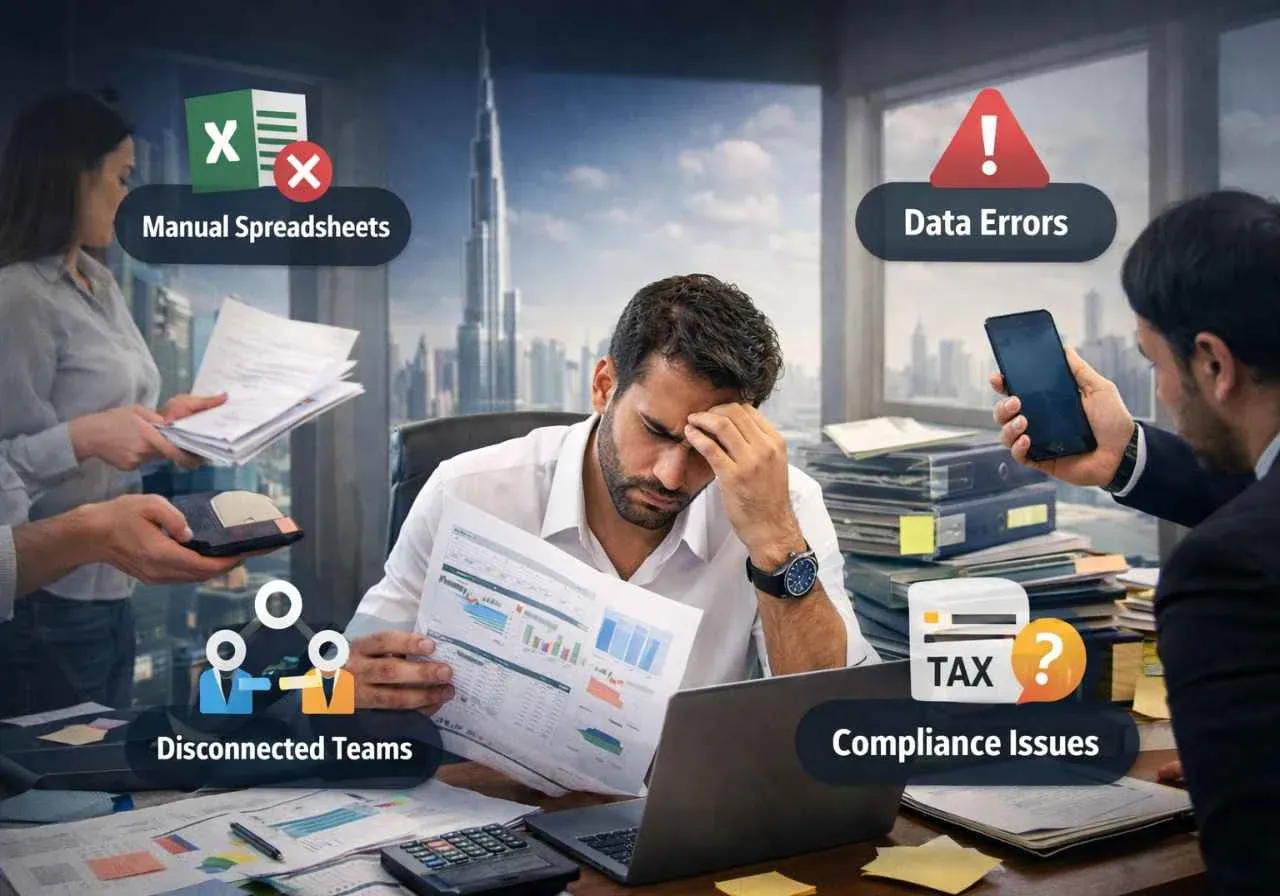
A company in Dubai may be invoicing in AED, buying in USD, managing multiple warehouses, tracking VAT properly, preparing for e-invoicing changes, and trying to keep financial reporting clean enough for audits, tax filing, and management review. When that is being handled through spreadsheets plus disconnected software, errors become a routine.
Top reasons UAE businesses implement ERP software
● Better control over finance, inventory, sales, and HR in one place.
● Cleaner VAT handling and tax-ready documentation.
● Stronger support for multi-currency and multi-entity operations.
● Faster management reporting.
● Fewer manual entry mistakes.
● Better audit trails and approval workflows.
● Easier growth across branches, warehouses, or business units.
Why is it especially relevant in the UAE in 2026
The UAE tax and compliance environment now expects businesses to be more structured than before.
● VAT remains a live operational requirement, with VAT returns due within 28 days from the end of the tax period, and VAT registration becomes mandatory once taxable supplies and imports exceed AED 375,000. Corporate tax also adds another reporting layer, with a 0% rate up to AED 375,000 of taxable income and 9% above that threshold. That changes the role of ERP from “nice to have” to “important infrastructure.”
● Then there is e-invoicing. The UAE Ministry of Finance states that the pilot programme will start on 1 July 2026, and it also makes clear that unstructured formats such as PDF, Word files, images, scans, and emails are not e-invoices. In other words, many businesses will need systems that can support structured invoice data and future-ready workflows, not just invoice printing.
● For real estate businesses, operational compliance has its own layer. Dubai Land Department services include registering and renewing tenancy contracts through Ejari, and businesses working in that space usually need systems that can handle contract, billing, tenant, and compliance workflows in a more organized way.
Key features of ERP software in the UAE in 2026
Not every ERP system fits every UAE business, but the strongest platforms usually cover these ERP features in the UAE.
- Finance and accounting
This is still the first reason many companies buy ERP. A proper finance module should help with:
● VAT-ready invoicing
● Tax calculation logic
● Chart of accounts control
● Audit trails
● Bank reconciliation
● Receivables and payables tracking
● Financial statements and management reports
In the UAE, finance modules matter because tax compliance is no longer something businesses can treat as a year-end cleanup exercise. The system needs to support regular filing discipline and reliable records.
- Inventory and supply chain
For trading, retail, manufacturing, and distribution businesses, ERP becomes much more valuable once inventory is involved.
Useful capabilities include:
● Multi-warehouse tracking
● Stock movement visibility
● Reorder rules
● Batch or serial tracking
● Landed cost control
● Purchase planning
● Instant valuation and availability
This is where many spreadsheet-driven businesses start feeling operational stress. Stock errors affect purchasing, billing, delivery, and customer trust all at once.
- HR and payroll
A lot of businesses underestimate this module until their headcount grows. The HR and payroll side of ERP must support:
● Employee records
● Leave tracking
● Payroll calculation
● Document management
● Attendance integration
● End-of-service benefit workflows
● Role-based approvals
In the UAE, annual leave rules and end-of-service entitlements are not minor admin topics. They affect payroll accuracy, employee trust, and compliance.MoHRE guidance states that annual leave is 30 days per year for employees completing one year of service, with proportional entitlement in certain shorter-service cases.
- CRM and sales
ERP is not only about back-office control. The right system can also improve revenue workflows.
A CRM and sales module can help teams manage:
● Land opportunities
● Quotations
● Sales orders
● Customer follow-up
● Approval steps
● Revenue forecasting
● Sales performance reporting
That matters when management wants to know not just what was sold, but what is likely to close, where deals are stuck, and how sales connect to finance and stock.
- Cloud and mobility
This is one of the biggest shifts in the ERP market. Businesses now expect ERP access from multiple offices, warehouses, project sites, or while traveling.Cloud ERP in Dubai is often chosen by businesses today because it includes remote access, browser-based dashboards, mobile usability, and easier update cycles. Some platforms also include AI-assisted dashboards or workflow suggestions, though the real value still comes from clean data and usable reporting.
Cloud ERP Software UAE vs On-Premise
| Factor | Cloud ERP | On-Premise ERP |
| Upfront cost | Lower starting cost | Higher initial investment |
| Deployment | Faster in many cases | Usually slower |
| Access | Anywhere with permissions | Mostly office/server dependent unless extended |
| Updates | Managed more easily | Often manual or partner-led |
| IT dependency | Lower internal infrastructure burden | Higher internal IT responsibility |
| Control | Strong, but vendor-hosted | More infrastructure control internally |
| Best fit | SMEs, growing firms, multi-location teams | Businesses with strict internal hosting preferences |
ERP software costs in Dubai and the UAE in 2026
This is the question most businesses ask first, and fairly so. The truth is that ERP Cost for Dubai businesses should depend less on the software name alone and more on users, modules, customization, integrations, deployment style, training depth, and support expectations.
Typical cost structure
Most ERP projects involve some mix of the following:
● Software license or subscription fees
● Implementation and configuration
● Data migration
● Customization
● User training
● Integration with other systems
● Annual support or AMC
Cloud ERP is commonly sold on recurring subscription terms, while implementation and custom work are often charged separately by vendors or partners.
Indicative planning ranges for 2026 (These are not fixed market rates)
| Business size | Typical ERP scope | Indicative starting budget |
| Small business / SME | Core finance, sales, inventory, basic HR | AED 15,000 - 40,000 initial project range |
| Mid-market | Multi-department ERP with workflows, reporting, and some customization | AED 45,000 - 120,000+ |
| Enterprise / complex group | Multi-entity, advanced workflows, integrations, deeper controls | AED 120,000 - 250,000+ |
For cloud subscriptions, businesses may also budget monthly or annual user-based costs on top of implementation.
For us, this is not just a marketing line. It is actually the sensible next step, because ERP cost becomes clear only after the scope is defined.
ROI and benefits of ERP for UAE businesses
ERP ROI in UAE businesses is usually a combination of cost control, faster work, fewer mistakes, and stronger visibility.
Where ROI usually appears
● Less duplicate data entry
● Faster monthly closing
● Better stock control
● Reduced invoice and reporting errors
● Better cash flow visibility
● Stronger approval discipline
● Lower dependence on individual staff memory
● Faster response from management because reports are available sooner
A practical example looks like this. A mid-sized Dubai retailer implements ERP across accounting, inventory, and invoicing. Within six months, invoice errors drop sharply, stock visibility improves, and management receives faster cash-flow reporting. A 75% reduction in invoice errors is entirely believable in businesses that previously relied on manual re-entry, especially when sales, billing, and stock records were disconnected before the ERP rollout. That number will vary by business, but the pattern is common.
The businesses that feel ERP ROI fastest are usually the ones already losing time and money through manual workarounds. If the current process is messy enough, ERP does not need years to prove its value.
ERP implementation process in the UAE
A successful ERP implementation in the UAE that businesses can trust usually follows a clear structure.
Step 1: Requirement gathering
Map what the business actually needs. Not what sounds impressive. This is not what every module can theoretically do. Start with finance, operations, reporting, compliance, and pain points.
Step 2: Vendor selection
Choose a vendor or implementation partner that understands UAE operations. Local experience matters when VAT logic, multi-currency setups, payroll realities, or sector-specific workflows are involved.
Step 3: Customization and configuration
This is where charts of accounts, tax rules, workflows, approvals, branches, warehouses, document formats, and dashboards are set up properly.
Step 4: Data migration
Poor data creates poor ERP outcomes. Therefore clean customer, supplier, stock, and accounting data before migration.
Step 5: Training and testing
Users need scenario-based training, not just feature tours. You must test the system against real UAE workflows.
Step 6: Go-live
Go-live should happen with support available, especially around finance, billing, stock movements, and access control.
Step 7: Ongoing support
ERP is not finished on the go-live day. Reporting needs change. Teams need refreshers. Compliance requirements evolve. That’s why ongoing support is important.
UAE compliance checkpoints during implementation
● VAT setup and tax mapping
● Invoice format readiness
● Corporate tax reporting discipline
● Role permissions and audit trails
● Payroll and leave configuration
● E-invoicing readiness for future phases
Choosing the right ERP software in the UAE
The best ERP is not the one with the longest feature list. It is the one your business can actually use well.
What to evaluate
● Does it support your industry properly?
● Can it handle UAE tax and reporting needs?
● Can it grow across your branches, users, and entities?
● Does the vendor offer local support?
● Can you get clear reporting without excessive customization?
● Will adoption be realistic for your staff?
Vendor checklist
● UAE implementation experience
● understanding of VAT, corporate tax, and local workflows
● transparent scope and pricing
● training capability
● support quality
● upgrade path
● integration flexibility
● strong reporting and audit visibility
This is the right move when the shortlist is still unclear. A short discovery session often saves businesses from choosing software based only on brand familiarity.
FAQs
ERP software is one system that keeps the main workflows of a business together. So instead of accounts using one tool, sales using another, and stock being tracked somewhere else, you can run everything through the same platform. In the UAE, that usually helps businesses work with less confusion, fewer repeated entries, and much better visibility across day-to-day operations.
Because by now, most businesses have reached the point where manual follow-up, spreadsheets, and disconnected software start creating more problems than they solve. In the UAE, especially, there is more pressure on reporting, tax handling, operational accuracy, and overall control. ERP helps businesses stay organized while making these routine tasks easier to manage.
There is no single price because it really depends on the size of the business and what the system is expected to handle. A company with basic finance and inventory needs will not spend the same as a business that wants multiple modules, custom workflows, integrations, approvals, and ongoing support.
Most businesses usually begin with the basics that affect daily operations first. That normally includes finance, accounting, inventory, sales, purchasing, reporting, and, in many cases, HR or payroll too. The exact mix changes from one company to another, but finance is usually where the need becomes urgent first because that is where control, compliance, and reporting all meet.
Yes, and this is one of the biggest reasons many businesses move to ERP in the first place. It helps you to keep invoices, tax calculations, records, and reports more consistent. That does not just save time. It also reduces the kind of manual mistakes that usually show up when teams are trying to prepare everything under pressure.
Yes, it can help quite a lot on the operational side. ERP does not replace tax advice, but it makes financial records cleaner, reporting more reliable, and transaction tracking easier to manage. That gives businesses a much better base when they need accurate numbers and properly organized accounts.
Cloud ERP is usually the easier option for businesses that want flexibility and quicker access without having to manage everything internally. On-premise ERP gives the company more control over hosting and infrastructure, but it also asks for more from the internal IT side.
That depends on how big the project is and how prepared the business is before it starts. A smaller setup can move fairly quickly. A larger ERP implementation in the UAE across departments usually takes a longer time because there is more data, more training, more approvals, and more testing involved.
No, not at all. A lot of growing businesses actually feel the benefit earlier because they are at the stage where things start slipping between teams, reports take too long, and too much depends on manual follow-up. ERP helps bring structure before those small daily issues turn into bigger operational problems.
Yes, a modern ERP can make that shift much easier. Businesses will need systems that can handle invoicing in a more structured and future-ready way, not just generate basic invoice files and leave the rest to manual work. That is exactly where a good ERP becomes useful, because it gives the business a better foundation before those changes become mandatory.
Conclusion
By this point, most businesses are no longer asking if they need better systems. The real question is if their current way of working can still support the speed, control, and accuracy the market now demands. In the UAE, that question has become even more important. VAT, corporate tax, e-invoicing readiness, multi-currency transactions, and growing operational complexity have made disconnected tools far harder to manage than they used to be.
That is exactly where ERP Software UAE becomes valuable as a practical business system that helps bring finance, inventory, HR, sales, and reporting into one clear structure.
So, the right ERP is rarely the one with the longest feature list. It is the one that fits how the business actually operates, supports compliance, and makes day-to-day work clearer as the company grows. For businesses looking at solutions built with these needs in mind, we offer Elate ERP, which is worth considering. It’s perfect, especially for companies that want a system that feels practical, business-focused, and aligned with UAE operational requirements rather than being overly complicated.
Book Your Free Elate ERP Consultation - Click Here